
Skip to content
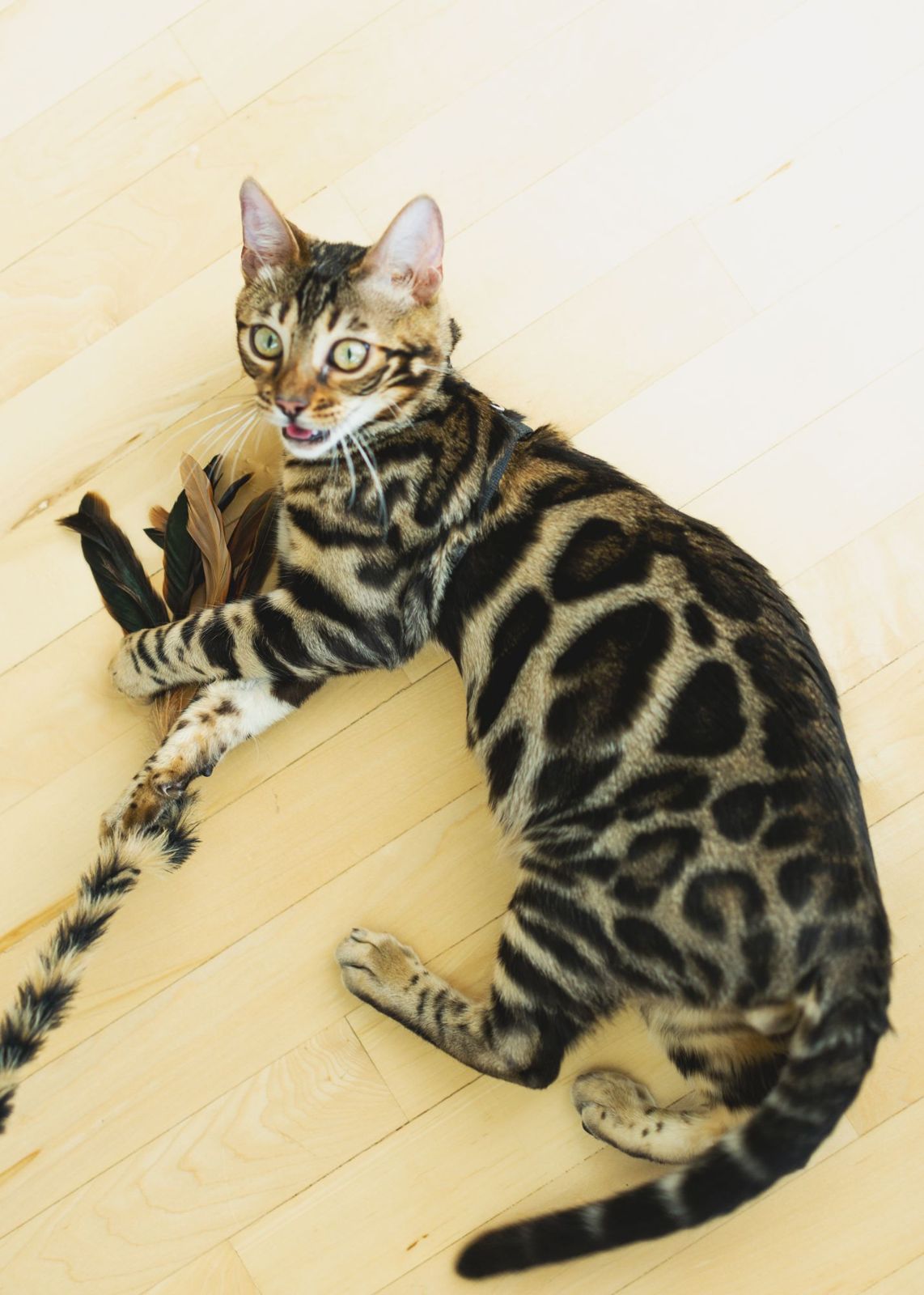
A marbled Bengal stretched out on the floor
The breed

The Bengal

The only domestic cat that can wear rosettes like a leopard, a jaguar or an ocelot.

Medium to large, richly coloured, highly contrasted, spotted or marbled. Loved by people who appreciate an inquisitive, loving cat.

A general description

The Bengal is a medium to large cat known for its richly coloured, highly contrasted coat of vivid spots or distinctive marbling. The breed was originally developed from crosses between domestic cats and the Asian Leopard Cat. Today’s domestic Bengal comes only from breeding Bengals to other Bengals and needs no specialised care.

Since the breed’s beginnings in 1986, its regal looks and charm have made it one of the most popular breeds anywhere. Breeders continue to develop these cats with careful selection for temperament, health and beauty. Bengals are shown at TICA events around the world and have a devoted following of owners who can’t imagine life with any other cat.

History

People have always been fascinated by the wild cats of the world’s jungles and forests. In 1963, Jean S. Mill crossed a domestic cat with an Asian Leopard Cat, a shy, spotted wild species from Asia weighing five to twelve pounds. It was the first effort to create a domestic breed with the loving nature of a fireside tabby and the striking look of a leopard, ocelot or jaguar.

The modern Bengal traces to cats Mrs. Mill bred from the early 1980s. The name comes from the Asian Leopard Cat’s scientific name, Prionailurus bengalensis. Early hybrid generations are registered as Foundation Bengals (F1, F2 and F3); they aren’t eligible for show, and only the females are used for breeding.

TICA accepted the Bengal as a new breed in 1986, and it gained championship status in 1991. It’s now one of the most frequently exhibited breeds in TICA. Breeders around the world have achieved what they set out to do: a docile, civilised house cat wearing the patterned coat of the jungle cats.

Personality

You can teach a Bengal good manners, but this is an active, inquisitive cat that loves to be up high. If you don’t want a cat leaving the floor, a Bengal probably isn’t for you.

Bengals are busy by nature. They’re very affectionate and will be a lap cat whenever they want to be, but their idea of fun is playing, chasing, climbing and investigating. Holding a Bengal in full play mode is like holding running water. They tend to save cuddles for sleepy time. Many love water and will join you while you brush your teeth or shower. Some are chatty; others are quiet and selective with their voice.

A Bengal will almost always want to be where you are, because that’s where the action is. Offer one a still toy and one that does wild, unpredictable things, and it picks the wild one every time. For people who enjoy rambunctious, funny, beautiful companionship, consider the Bengal.

Coat, colour and build

The Bengal is best known for its short, soft, luxurious coat in a spotted or marbled pattern. Some coats carry glitter, an iridescent sheen on each hair.

Spotted

The pattern most associated with the leopard look. Spots can be large or small and often include rosettes, the two-toned spots seen on jaguars and leopards.

Marbled

A derivative of the classic “bull’s eye” tabby pattern, especially dramatic in Bengals: random swirls or thick diagonal and horizontal lines flowing across the coat.

Colours

Brown/black tabby is the most popular colour, a plain name for coats that run from cool grey to golden, bronze, copper or mahogany, with markings from rich brown to intense black. The snow colours, a form of albinism from Siamese and Burmese ancestry, give an ivory, cream or light tan coat with markings from light brown to dark chocolate and blue to aqua eyes. Silver Bengals have grey to nearly white backgrounds with dark grey to black patterns. Many Bengals have nearly white undersides and facial markings that still show the tabby pattern.

At Brigite’s Bengals we work with Brown, Snow (Lynx, Mink and Sepia), Silver, Charcoal and Melanistic Bengals, each with its own contrast, pattern clarity and tonal depth. Colour reflects lineage, structure and development over time. Read our full guide to Bengal colours and patterns.

Size

Bengals weigh 6 to 15 pounds, with males generally larger than females. A healthy Bengal is well muscled and looks athletic, and no physical feature should appear exaggerated.

Bengals are confident, curious and devoted. They get along with other pets when properly introduced and love being part of a family. Each one is an individual, so learn as much as you can about the breed before bringing one home.

Questions we hear often

Are Bengal cats good pets?
Yes, for the right home. Bengals are intelligent, social and highly interactive, and they form strong bonds with their people. They thrive with daily play, enrichment and routine. A Bengal suits a household that wants an engaged, active companion rather than a low-maintenance or independent cat.
Do Bengal cats require more attention than other breeds?
Yes. Bengals need more attention and stimulation than many domestic breeds. They’re clever and energetic, so they do best with interactive play, places to climb and mental enrichment. Without it, a Bengal can get bored or overly vocal. How Bengals differ from other breeds.
Are Bengal cats high-energy?
Bengals are a high-energy breed. They’re athletic and agile, and love climbing, jumping and interactive play. Vertical space, scratching posts and daily play sessions meet their physical and mental needs and support healthy behaviour.
Are Bengal cats vocal?
Bengals are communicative rather than constantly loud. They chirp, trill and use expressive sounds to talk with their people. Vocalising is usually a sign of engagement, curiosity or excitement, not stress.
Do Bengal cats get along with other pets?
They can get along well with other cats and cat-friendly dogs when introductions are handled properly. Early socialisation and gradual introductions matter. Because Bengals are confident and energetic, compatibility depends on the temperament of both animals more than on breed.
Are Bengal cats hypoallergenic?
No cat breed is completely hypoallergenic, Bengals included. Some people with mild allergies report fewer reactions to Bengals because of their short coat and lighter shedding. Sensitivity varies by person, so spend time with the breed before bringing one home. Our honest answer on allergies.
Are Bengal cats legal in Canada?
Yes. Reputable Bengal breeders keep their cats fully domestic and several generations removed from their wild ancestors, so Bengals from established breeders meet Canadian domestic cat regulations. Laws vary internationally. Why some breeds are banned in certain countries.
How much exercise do Bengal cats need?
Daily exercise and mental stimulation. Interactive play, climbing structures, puzzle toys and enrichment keep them balanced, and a well-stimulated Bengal is calmer indoors. We take ours on walks and harness-train every kitten. Here’s how.
How long do Bengal cats live?
With proper care, nutrition and veterinary support, Bengals commonly live 12 to 16 years, and many live longer. Genetics, diet quality, activity level and preventive care all shape lifespan.
Are Bengal cats destructive?
Not naturally, but they’re curious and smart. Without outlets they’ll climb, explore and investigate your things. Scratching posts, climbing structures and enrichment prevent unwanted behaviour and give their instincts somewhere to go.
How do I choose a reputable Bengal breeder in Calgary, or anywhere?
Look for a breeder registered with a recognised association such as TICA, who puts health and temperament first, raises kittens in the home, and provides clear contracts and guidance. Ethical breeders focus on long-term well-being, not volume or quick placement.
Is a Bengal the right breed for me?
A Bengal is ideal for people and families who want an interactive, intelligent, engaging companion, and who value routine, enrichment and being involved. They’re not suited to owners looking for a low-energy or hands-off pet.
Ready to meet one?

See who’s available, or join the waitlist for the next litter.

Kittens available