
Journal / Health
Your Cat Ran Away: What to Do Immediately (and Why Offering a Reward Matters)
December 23, 2025 · 3 min read


If your cat has gone missing, take a breath. Most cats who “run away” are not gone forever — but what you do in the first 24–72 hours can make a real difference.
This guide walks through exactly what to do if your cat disappears, how long cats typically stay hidden, and why offering a reward — clearly and early — often works.
My Cat Ran Away! How Cats Actually Disappear (and Why It’s Misleading)
Most missing cats aren’t running away.
They are:
- Hiding nearby
- Trapped accidentally (garages, sheds, stairwells)
- Disoriented after a scare
- Quietly sheltering, not wandering
Cats do not behave like dogs when lost. They tend to stay close and stay silent — especially indoor cats.
This is why immediate, loud searching often fails.
Step 1: Start Close — Very Close, Your Cat probably ran fast but not far
Before canvassing miles, search within a 3–7 house radius.
Do this first:
- Check under decks, porches, bushes, crawl spaces
- Look inside garages, sheds, basements (ask neighbors directly)
- Search at dawn and dusk when cats are more likely to move
- Bring a flashlight — eye shine matters
Call softly. Shake treats. Sit quietly.Fear often keeps cats frozen, not fleeing.
Step 2: Put Familiar Scent Outside (But Be Strategic)
Place:
- Your cat’s bedding
- A worn item of your clothing
Near the point they escaped.
Avoid scattering items everywhere — you want a clear scent anchor, not confusion.
Step 3: Posters Matter — and So Does a Reward
This is where many people hesitate — and shouldn’t.
Why offering a reward works
A visible reward:
- Motivates people to actually look, not just glance
- Encourages someone to check sheds, garages, and cameras
- Signals that the cat is deeply missed and actively searched for
You don’t need to list an amount publicly — “Reward Offered, my Cat Ran Away from his loving family” is enough.
People are far more likely to:
- Open their garage
- Check their basement
- Review doorbell footage
…if there’s incentive.
Step 4: Use Social Media Intentionally
Post in:
- Local Facebook groups
- Neighbourhood pages
- Lost & found pet groups
Include:
- Clear photos
- Location + cross streets
- Distinctive features (coat pattern, neutered status, collar, microchip)
This is especially important for Bengals and exotic-looking cats.
The Onyx Story: Why Breed Recognition Matters
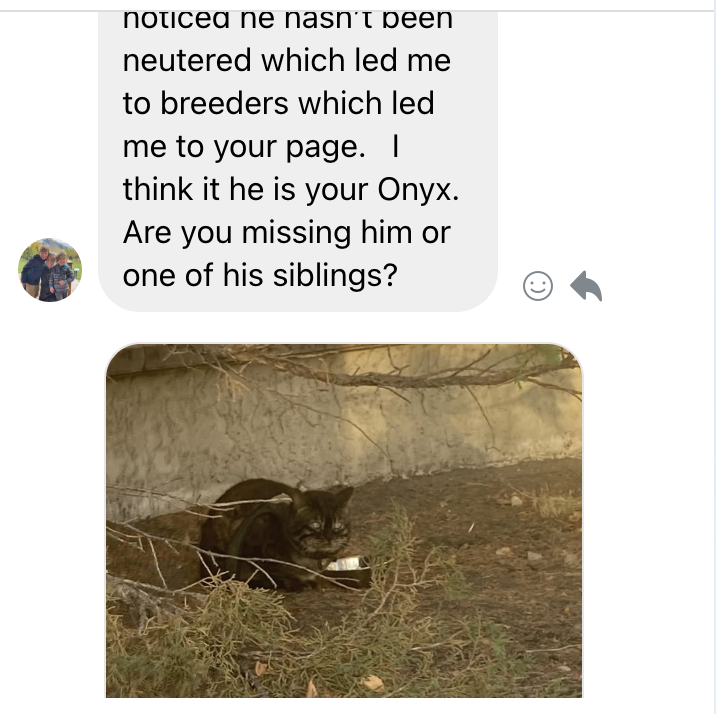
We have a Bengal named Onyx who went missing in the dead of winter.
Days passed. It was almost a week.
We were terrified. At one point, we genuinely feared he had frozen — we joked grimly that he might be a popsicle, but the fear was very real.
Then we got a message on Facebook.
A family had found him and reached out because:
- He was neutered
- He had a distinctive Bengal coat
- They assumed he must belong to a local breeder or cattery
That recognition is what brought him home.
Without social posts — and without people understanding that neutered Bengals don’t just belong outside — Onyx might never have made it back.
Step 5: Understand How Long Cats Truly Disappear For
This is important for your sanity.
Typical timelines:
- 24–72 hours: Most cats are hiding very close
- 3–7 days: Still very recoverable, often trapped or sheltering
- 1–3 weeks: Cats can survive longer than you think, especially if someone is feeding them unknowingly
- Months later: Yes — cats have returned after months
Cold, fear, and hunger don’t always force movement.Sometimes time + visibility is what brings them home.
Step 6: Don’t Give Up — Change Tactics
If days pass:
- Refresh posters
- Re-post with updated wording
- Add a reward if you haven’t
- Knock on doors again (politely, directly)
Most “miracle returns” aren’t miracles — they’re persistence
Prevention Starts Before the Door Opens
The best way to handle a lost cat is to prevent the situation altogether. For kittens and curious indoor cats, early harness training can dramatically reduce the risk of door-dashing or panic escapes. When cats are gradually introduced to a properly fitted harness and supervised outdoor time, they’re less likely to bolt when faced with unfamiliar sounds or open doors. At the same time, in-home monitoring cameras add an extra layer of protection—allowing you to understand your cat’s routines, track door-related behaviour, and spot escape attempts before they become emergencies. Prevention isn’t about restriction; it’s about visibility, training, and setting your cat up for safe independence.
.
Final Thoughts: Fear Is Normal — But Hope Is Reasonable
Losing a cat is terrifying. The waiting is brutal. The silence is the hardest part.
But cats are resilient. People are often kinder than we expect. And visibility — especially when paired with incentive — works.
If your cat is missing:
- Start close
- Be visible
- Offer a reward
- Use your community
And don’t assume the worst — even in winter.